
<日本語ページへ>
Fukuchiyo Sake Brewery & Olivier Chaignon: A New Nabeshima
A groundbreaking collaboration between the globally acclaimed Nabeshima sake, renowned for its numerous accolades, including being named the top sake in the prestigious International Wine Challenge (IWC), and Olivier Chaignon, the celebrated three-Michelin-star executive chef of seven consecutive years at L’Osier, has yielded a remarkable new sake: Nabeshima Microbiome Ginpu.
This exceptional brew features Ginpu sake rice, sourced from the abundant fields of Hokkaido’s Asahikawa region, cultivated through the pioneering microbiome farming method promoted by Olivier Chaignon.
This visionary partnership was born from a mutual aspiration to create a sake that complements the nuances of French gastronomy.
The Chef ’s Take: Olivier Chaignon
It is a great honor for me to have had the opportunity to create this sake together with the genius master brewer, Mr. Iimori.
This Nabeshima Microbiome Ginpu uses high-quality water that flows abundantly from the Taradake mountain range, sake rice grown using the microbiome farming method that I promote, and the philosophy and techniques of Fukuchiyo Sake Brewery, led by Mr. Iimori.
Mr. Iimori brews sake in a way that allows the rice to express its original deliciousness to the fullest without forcing the flavor to fit a standard. Despite receiving numerous international accolades, his belief in brewing natural sake without pursuing expansion and my desire to promote microbiome farming have fortunately come together.
I hope many of you will enjoy this new addition to the Nabeshima brand, with its gentle and evocative character.
A message from the Master Brewer of Fukuchiyo Sake Brewery
Historically, I’ve approached collaborations with other brands cautiously, driven by my profound commitment to preserving the integrity and aesthetic vision of the Nabeshima sake brand. My primary concern has always been protecting our distinctive identity from dilution or misalignment.
It is a tremendous honor to have connected and collaborated with the team at L’Osier and Chef Chaignon. As a true master in French cuisine, Chef Chaignon embodies excellence not only through his technical skill and refined sensibility, but through his profound respect for ingredients and unwavering commitment to perfection in every detail.
Having devoted my life to the art of sake brewing, I discovered through my conversations and collaborative experiments with Chef Chaignon that despite our different disciplines, we share a fundamental ability to recognize essence and a passionate dedication to realizing our creative visions. Though our crafts differ, I found myself repeatedly inspired by the moments when our artistic aspirations aligned, connecting with him deeply as a fellow artisan.
I was also profoundly moved by the evident pride demonstrated by everyone at L’Osier—Shiseido’s flagship establishment and a premier Japanese luxury brand—and by the exquisite elegance that permeates their cuisine, atmosphere, and service.
This unprecedented collaboration represented a significant challenge for Nabeshima, but the knowledge gained and joy experienced have been immeasurable, infusing our sake brewing tradition with fresh inspiration and vitality.
I extend my deepest gratitude for this remarkable opportunity, and wish to sincerely thank all the farmers whose support made this endeavor possible. Moving forward, Nabeshima will remain true to its core principles while remaining open to meaningful collaborations that contribute to our continued evolution and growth.
Crafting Character: The Defining Stages
Our sake is brewed carefully under the supervision of artisans, from meticulously selecting sake rice and high-quality water to undergoing the thorough fermentation process. Olivier Chaignon not only contributed to the flavor profile development of this batch but also actively participated in the cultivation of the sake rice, the making of the koji (malted rice), and the inoculation of the koji mold.
In collaboration with Mr. Yasutomo, an organic JAS-certified sake rice farmer in Asahikawa, Hokkaido, lactic acid bacteria and their metabolites were applied to a designated section of Yasutomo Farm’s soil multiple times from early July 2024. This application aimed to foster a microbiome-rich soil environment. The efforts culminated in a successful autumn harvest of Ginpu sake rice.
The harvested Ginpu rice then proceeded through the traditional steps of sake production: polishing, washing, soaking, and steaming. Notably, Chef Chaignon was also involved in the subsequent koji-making stage.
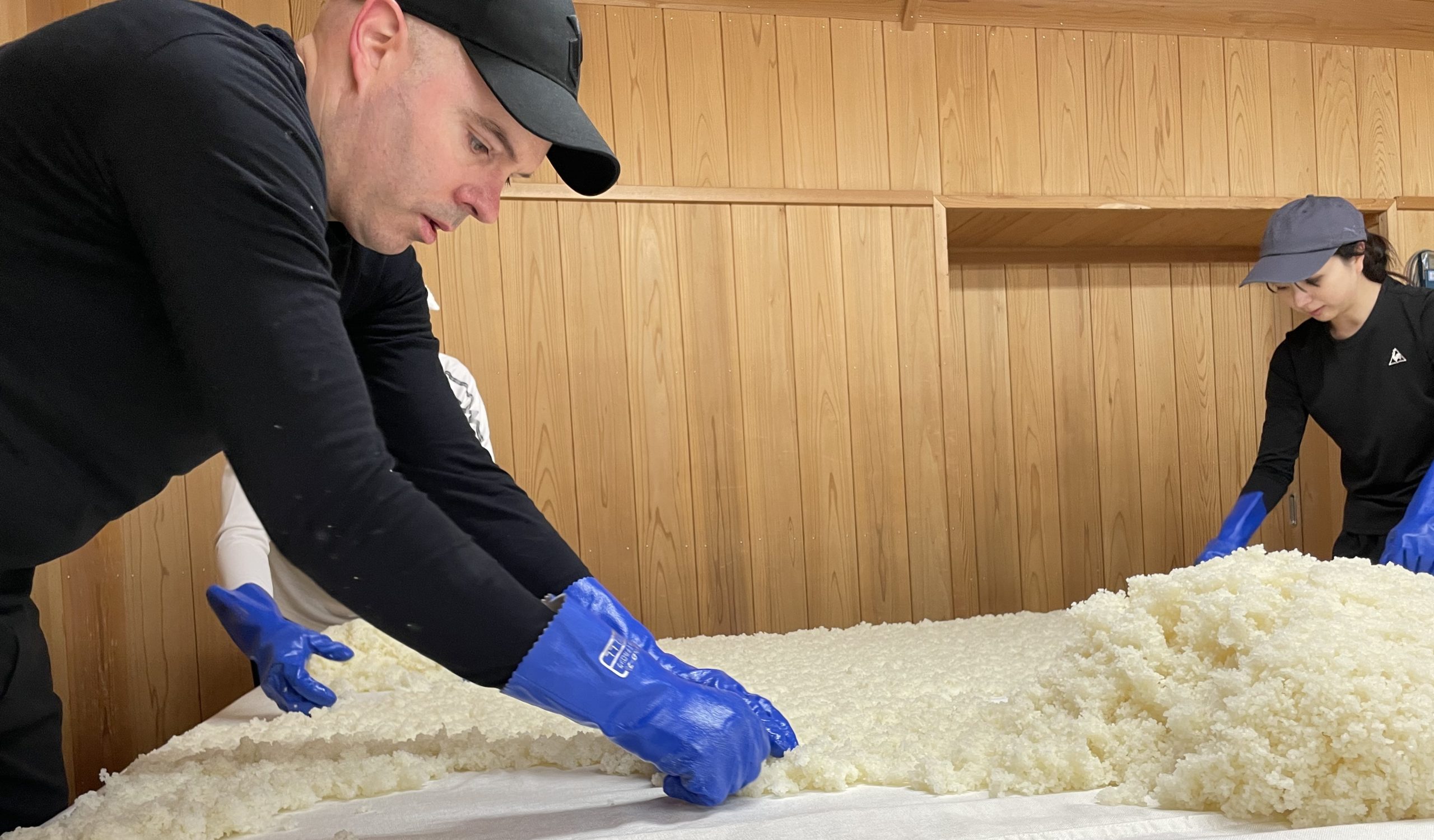
To quickly cool the steamed rice by spreading it while still hot, Chef Chaignon moved swiftly as a vital member of the team.
Simultaneously, we cultivated a high-quality shubo (yeast starter) for sake fermentation. Uniquely for this collaboration, the starter incorporated the same type of lactic acid bacteria scattered on the soil where the sake rice was grown, raising Chef Chaignon’s expectations for its flavor influence.
Once the koji and shubo is ready, the process advances to the moromi (the main mash during sake fermentation) stage.
Chef Chaignon experienced firsthand the physical strength required to control the paddle to stir the moromi.
Afterward, through pressing, sedimentation, filtration, and pasteurization, the sake was finally stored and bottled for completion!
Microbiome Farming Method
“Microbiome Farming” is an organic, pesticide-free agricultural technique that employs carefully chosen lactic acid bacteria and their metabolic products. Fundamentally, it is an environmentally regenerative agriculture that works with natural microorganisms in the environment.
In Japan, conventional agriculture, which accounts for 99% of current practices, involves chemical fertilizers and pesticides. In contrast, organic farming, which focuses on soil building without using pesticides, herbicides, or chemical fertilizers, remains at a mere 0.5% within the country (Source: Ministry of Agriculture, Forestry and Fisheries (Japanese only)).
Countless microorganisms and fungi naturally inhabit the soil. However, pesticides and chemical fertilizers can also kill the beneficial microorganisms and fungi important for soil nutrients, resulting in soil degradation.
In contrast, microbiome farming is a form of pesticide-free cultivation that aims to grow crops from the soil by leveraging the full potential of naturally occurring microorganisms in the environment, including those in the soil and on plants.
Microbiome farming involves scattering a specific lactic acid bacterium in the soil to develop a unique microbial ecosystem for cultivating vegetables and fruits. This enables organic agriculture that repels pests without the need for chemical fertilizers or pesticides.
Moreover, when raising livestock such as chickens and ducks, adding the same lactic acid bacteria to their feed helps regulate their gut health. This allows them to stay consistently healthy, thus eliminating the need for antibiotics and other substances.